Neovenator salerii in 3D
My first skeletal reconstruction in 3D was of the skull of Neovenator, which remains my favourite theropod and likely my favourite dinosaur. As my skills in 3D modelling, particularly in skeletal reconstructions, have improved, I have decided to undertake a full 3D reconstruction of this taxon.
Background on Neovenator:
Neovenator was an early carcharodontosaurian from the Wessex Formation (Barremian, Early Cretaceous) of England. The Wessex Formation is among the most significant dinosaur fossil sites in the United Kingdom and is internationally recognised for representing a period and locality that is otherwise underrepresented in the fossil record.
The Barremian, the geological age during which Neovenator lived, represents one of the few intervals in the Mesozoic when most of what is now the United Kingdom was not submerged by seas. Consequently, this period is one of the only terrestrial Mesozoic intervals in the UK where dinosaur remains are consistently discovered. The Wessex Formation, in particular, is interpreted as a Mediterranean-like environment. Geological evidence indicates that a large river traversed the Wessex outcrops on the Isle of Wight, bordered by chaparral-like vegetation in the lowlands and coniferous forests at higher elevations.
Many dinosaur fossils from the formation are recovered from the so-called “plant debris beds,” which are sections characterised by grey mudstone containing charred remains of ancient plant material. The prevailing hypothesis is that infrequent lightning storms ignited wildfires, which burned the surrounding environment. The charred remains of organisms caught in these fires were subsequently transported by rainwater and debris flows into ponds, lakes, and streams, where both fauna and flora ultimately became fossilised.
Neovenator itself was found in one of these plant beds, specifically the L9 plant debris bed near Grange Chine. Most, if not all, remains (as far as I know) of Neovenator have been found in the various plant debris beds on the IOW, with the vast majority of remains known from the L9 bed. It has been suggested that this may mean that Neovenator preferred the upland habitat of the Wessex formation - but this could also be preservation bias, as the other horizons are not nearly as fossiliferous for large vertebrates.
The holotype of Neovenator was found alongside what is now the holotype of Brighstoneus, a medium-sized iguanodontian. It’s perhaps unlikely that these two specimens represent a predator-prey reaction, but from the pathologies found on the holotype specimen of Neovenator, we can tell that this predator had a rough life. Whether or not the holotype was nearing the end of its life is unclear, although the majority of individuals of Neovenator are around 10% the size of the holotype specimen, suggesting that if this individual wasn’t fully grown, it was at least nearly there.
The skeletal
Ok, as the comments on my other blogs would suggest, some of you don’t like reading. So let’s cut to the chase:
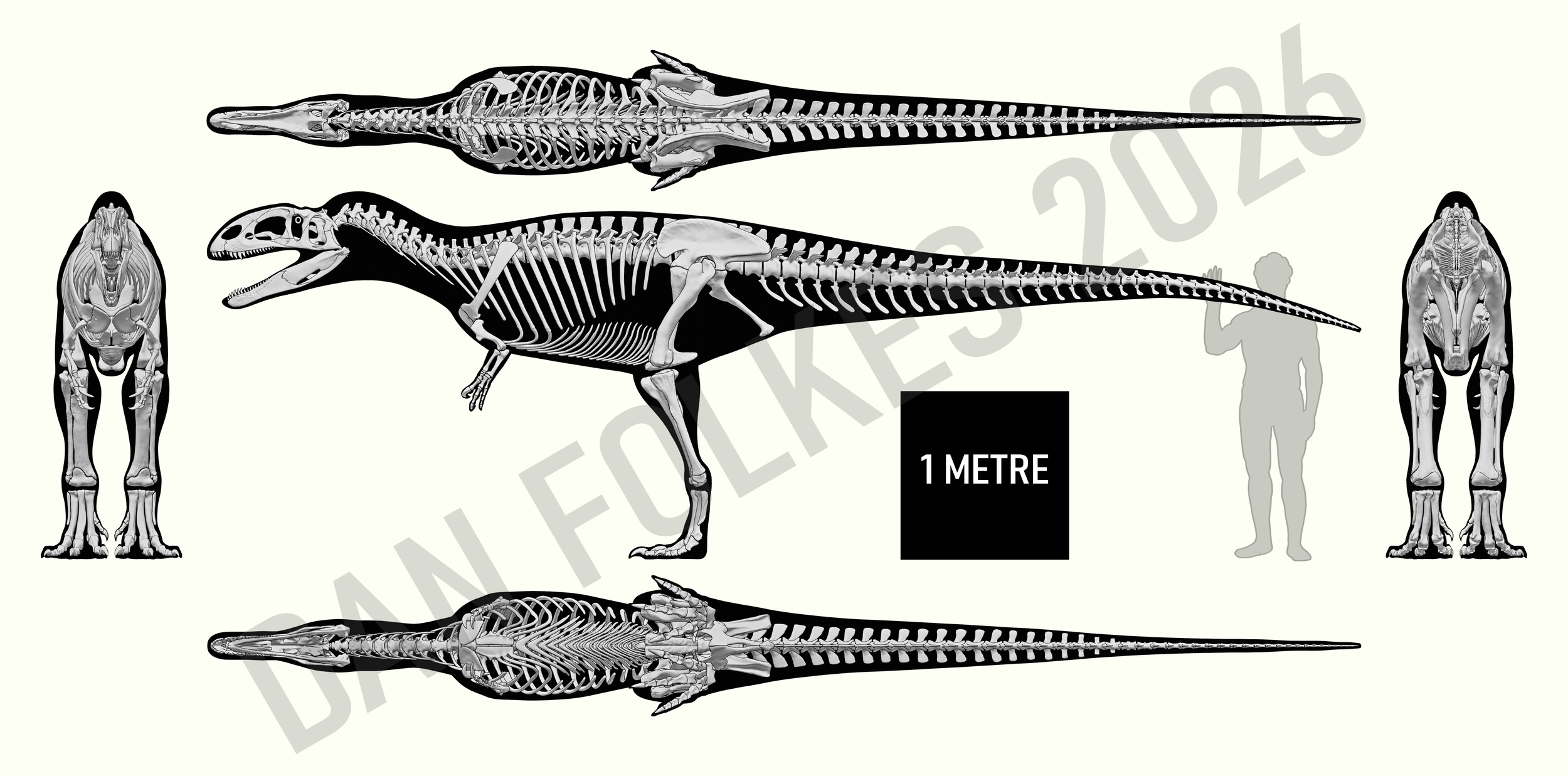
Neovenator salerii 3D reconstruction. Scale bar = 1 metre. Size is based on the holotype specimen.
The holotype specimen was the main base for this reconstruction. Being over 70% complete, Neovenator represents one of the most complete theropod dinosaur skeletons known on the continent.
This specimen only preserves the anterior portion of the skull, so the unknown areas were reconstructed based on related genera such as Concavenator, Acrocanthosaurus, and Allosaurus. The only other areas that were reconstructed based on other taxa were the arms, which I based on Concavenator and Allosaurus. Contrary to what some may believe, Neovenator preserves no forelimb material, and previous reconstructions showcasing long arms were likely based on the megaraptoran anatomy; previous research suggested that this group of tetanurans were related to Neovenator and other carcharodontosaurians in the family Neovenatoridae. Subsequent research shows that instead, megaraptorans were coelurosaurs more closely related to tyrannosauroids, whereas Neovenator itself was almost certainly a carcharodontosaurian.
My reconstruction represents an animal around ~7 metres in length. Certain specimens, such as MIWG 5470, and a potential footprint referrable to Neovenator (IWCMS 2016.273), suggest that larger individuals around 8 or more metres in length may have existed - but these specimens are much more fragmentary and so their size estimate is more dubious.
This was a lot of fun. I’m really enjoying the 3D skeletals, and you can expect a lot more from me in this medium in the future.
References
Brusatte, S.L., Benson, R.B. and Hutt, S., 2008. The osteology of Neovenator salerii (Dinosauria: Theropoda) from the Wealden group (Barremian) of the Isle of Wight. Monographs of the Palaeontographical Society, 162(631), pp.1-75.
Cuesta, E., Ortega, F. and Sanz, J.L., 2018. Appendicular osteology of Concavenator corcovatus (Theropoda: Carcharodontosauridae) from the lower cretaceous of Spain. Journal of Vertebrate Paleontology, 38(4), pp.1-24.
Cuesta, E., Vidal, D., Ortega, F. and Sanz, J.L., 2018. The cranial osteology of Concavenator corcovatus (Theropoda; Carcharodontosauria) from the Lower Cretaceous of Spain. Cretaceous Research, 91, pp.176-194.
Eddy, D.R. and Clarke, J.A., 2011. New information on the cranial anatomy of Acrocanthosaurus atokensis and its implications for the phylogeny of Allosauroidea (Dinosauria: Theropoda). PloS one, 6(3), p.e17932.
Lockwood, J., 2016. Ichnological evidence for large predatory dinosaurs in the Wessex Formation (Wealden Group, Early Cretaceous) of the Isle of Wight. Proceedings of the Isle of Wight Natural History and Archaeological Society, 30, pp.103-110.
Madsen, J.H., 1976. Allosaurus fragilis: a revised osteology.
Sweetman, S.C. and Insole, A.N., 2010. The plant debris beds of the Early Cretaceous (Barremian) Wessex Formation of the Isle of Wight, southern England: their genesis and palaeontological significance. Palaeogeography, Palaeoclimatology, Palaeoecology, 292(3-4), pp.409-424.
Special thanks to my patrons for their continuous support!
Liam Elward
Stephen O’connor
Mark Williams
Shmi