Giganotosaurus, but the 3D version
I’ve had a long history with Giganotosaurus, ever since my first skeletal diagram in 2021/2022. Overall, I’ve revised Giganotosaurus around 6 times (what can I say, I’m a perfectionist), and as I get more data on the holotype specimen, the more I want to update my skeletal diagram to be as close to what is known as possible.
Over the past year or so, I’ve managed to speak to several people who have had first hand experience with the material (contrary to what has circulated online - I haven’t actually seen the Giganotosaurus holotype in person, but I would absolutely love to at some point - special thanks to Rommel Heinz, Warpath, and other workers at the Ernesto Bachmann museum who have been critical in my further understanding of this animal, and in turn have allowed me to create this 3D reconstruction).
For those of you not in the know, here’s a little about the literature on Giganotosaurus:
Giganotosaurus was first described by Coria and Salgado in 1995. Despite the skeleton being mentioned to be rather complete (possibly around 75% of the body), the initial description was limited and featured only images of select elements of the cranial material, which were not of the best quality. Subsequent literature has provided only a few images of the holotype specimen, with a handful of papers featuring limited images of the postcranial remains. Thus, creating skeletal diagrams of Giganotosaurus has been complex, which largely explains the differences in proportions online among various artists who have attempted to reconstruct this enigmatic taxon.
Conflicting measurements also exist for the material that has been described; notably, the femur has been given lengths of 1365 mm to over 1400 mm in length, and it’s been a pain deciphering which of these is more “correct” (these measurements are probably to do with the difficulty of measuring a not-straight femur in a straight line… It could also be due to the dimensions of the two femora being slightly different, or the measurement of the casts. However, I believe the first explanation is the most likely.)
Luckily, with more information on the holotype becoming accessible, and with upcoming literature and material on the horizon on Giganotosaurus, our understanding of this taxon has increased - hence, why my reconstructions have changed several times; because my knowledge of the material, and my experience in skeletal reconstruction, have increased.
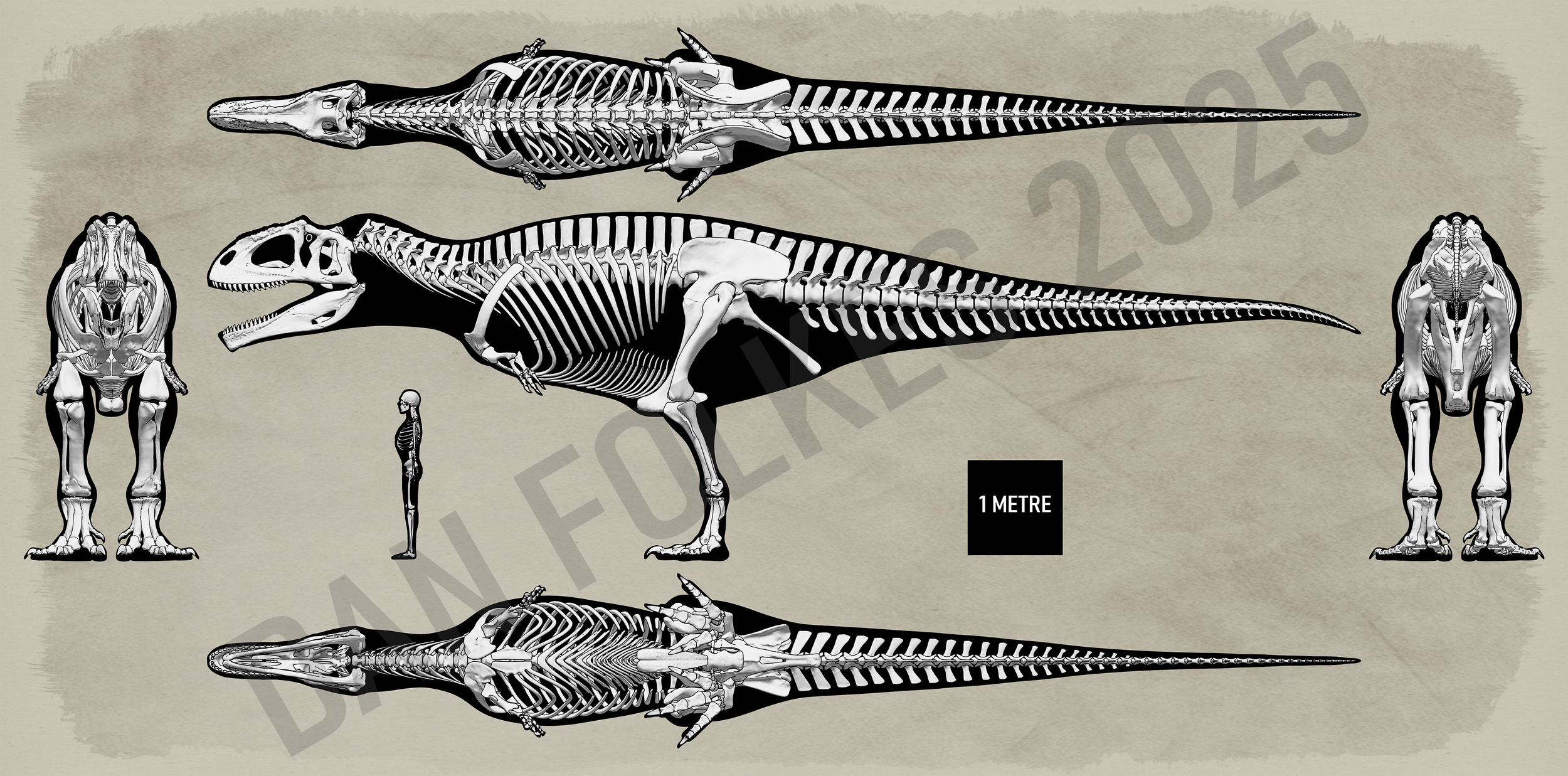
The 3D reconstruction of Giganotosaurus carolinii - because a 3D representation of a skeleton is a far better representation of an extinct taxon than a simple 2D lateral one.
For the skull:
I cross-scaled the skull material of several derived carcharodontosaurid genera to determine a “best fit” model for a generalised carcharodontosaurid skull
I then scaled the known material of Giganotosaurus, with the images of the cranial material (including the unfigured nasal and premaxilla) scaled to the correct sizes and inserted into this “best fit” model
I realised that in my previous reconstruction, I had reconstructed the maxilla too large, and it probably would have been shorter and thicker in height (this was something Coria himself commented on my previous reconstruction).
Missing elements were restored using Meraxes, Taurovenator, Mapusaurus, Carcharodontosaurus, and Acrocanthosaurus.
For the appendicular skeleton:
The forelimbs were based exclusively on Taurovenator, which, from my personal experience with these taxa, seems to have been proportioned more similarly to Giganotosaurus than Meraxes. The manual unguals were restored using those of the latter taxon.
The hindlimbs, being mostly complete, were based on Giganotosaurus itself (thanks to Rommel in particular for helping me with the general form of the femora). The pes was based on Taurovenator (as I mentioned, I believe this taxon to be a better fit than Meraxes).
The pelvic and pectoral girdles are mostly complete in Giganotosaurus - the missing areas of the scapula were based on Meraxes.
For the axial skeleton:
Restored using known Giganotosaurus vertebrae
Deformed vertebrae restored using more complete vertebrae in the series, as well as comparison with other taxa (mentioned below)
Missing elements, eg, the caudal/cervical neural spines, were restored using Mapusaurus, Taurovenator, Tyrannotitan, and Meraxes, edited to the known proportions of the more complete Giganotosaurus material (for example, the cervical neural spines were scaled down in height to match the height of the atlas, which is mostly complete in Giganotosaurus.
Ribs and Gastralia were based on the known material in Giganotosaurus, followed by Taurovenator and supplemented with the series in Acrocanthosaurus to determine the sequence.
References used in this reconstruction will now follow:
Skull
Canale, J.I., Apesteguía, S., Gallina, P.A., Mitchell, J., Smith, N.D., Cullen, T.M., Shinya, A., Haluza, A., Gianechini, F.A. and Makovicky, P.J., 2022. New giant carnivorous dinosaur reveals convergent evolutionary trends in theropod arm reduction. Current Biology, 32(14), pp.3195-3202.
Canale, J.I., Novas, F.E., Salgado, L. and Coria, R.A., 2015. Cranial ontogenetic variation in Mapusaurus roseae (Dinosauria: Theropoda) and the probable role of heterochrony in carcharodontosaurid evolution. Paläontologische Zeitschrift, 89, pp.983-993.
Canale, J.I., Palombi, D, (2023-2024) Online communication with Dan Folkes through Warpath MT
Coria, R.A. and Salgado, L., 1995. A new giant carnivorous dinosaur from the Cretaceous of Patagonia. Nature, 377(6546), pp.224-226.
Eddy, D.R. and Clarke, J.A., 2011. New information on the cranial anatomy of Acrocanthosaurus atokensis and its implications for the phylogeny of Allosauroidea (Dinosauria: Theropoda). PloS one, 6(3), p.e17932.
Ibrahim, N., Sereno, P.C., Varricchio, D.J., Martill, D.M., Dutheil, D.B., Unwin, D.M., Baidder, L., Larsson, H.C., Zouhri, S. and Kaoukaya, A., 2020. Geology and paleontology of the upper cretaceous Kem Kem group of eastern Morocco. ZooKeys, 928, p.1.
Madsen, J.H., 1976. Allosaurus fragilis: a revised osteology.
Rolando, A.M.A., Motta, M.J., Agnolín, F.L., Tsuihiji, T., Miner, S., Brissón-Egli, F. and Novas, F.E., 2024. A new carcharodontosaurid specimen sheds light on the anatomy of South American giant predatory dinosaurs. The Science of Nature, 111(6), p.56.
Postcrania
Canale, J.I., Apesteguía, S., Gallina, P.A., Mitchell, J., Smith, N.D., Cullen, T.M., Shinya, A., Haluza, A., Gianechini, F.A. and Makovicky, P.J., 2022. New giant carnivorous dinosaur reveals convergent evolutionary trends in theropod arm reduction. Current Biology, 32(14), pp.3195-3202.
Canale, J.I., Novas, F.E. and Pol, D., 2015. Osteology and phylogenetic relationships of Tyrannotitan chubutensis Novas, de Valais, Vickers-Rich and Rich, 2005 (Theropoda: Carcharodontosauridae) from the Lower Cretaceous of Patagonia, Argentina. Historical Biology, 27(1), pp.1-32.
Canale, J.I., Palombi, D, (2023-2024) Online communication with Dan Folkes through Warpath MT
Coria, R.A. and Currie, P.J., 2006. A new carcharodontosaurid (Dinosauria, Theropoda) from the Upper Cretaceous of Argentina. Geodiversitas, 28(1), pp.71-118.
Coria, R.A. and Salgado, L., 1995. A new giant carnivorous dinosaur from the Cretaceous of Patagonia. Nature, 377(6546), pp.224-226.
Currie, P.J. and Carpenter, K., 2000. A new specimen of Acrocanthosaurus atokensis (Theropoda, Dinosauria) from the lower Cretaceous Antlers formation (lower Cretaceous, Aptian) of Oklahoma, USA. Geodiversitas, 22(2), p.207.
Heinz, Rommel (2025) Online communication with Dan Folkes
Madsen, J.H., 1976. Allosaurus fragilis: a revised osteology.
Rolando, A.M.A., Motta, M.J., Agnolín, F.L., Tsuihiji, T., Miner, S., Brissón-Egli, F. and Novas, F.E., 2024. A new carcharodontosaurid specimen sheds light on the anatomy of South American giant predatory dinosaurs. The Science of Nature, 111(6), p.56.
Once again, special thanks to Rommel Heinz, Warpath, and other workers who have helped me immensley by providing me the information I’ve needed to create this reconstruction. I hope it serves all you paleoartists well in enabling a better understanding of giganotosaurine anatomy.
As always, thank you to my patrons:
Liam Elward
Mark Williams
Stephen O'Connor
Shmi