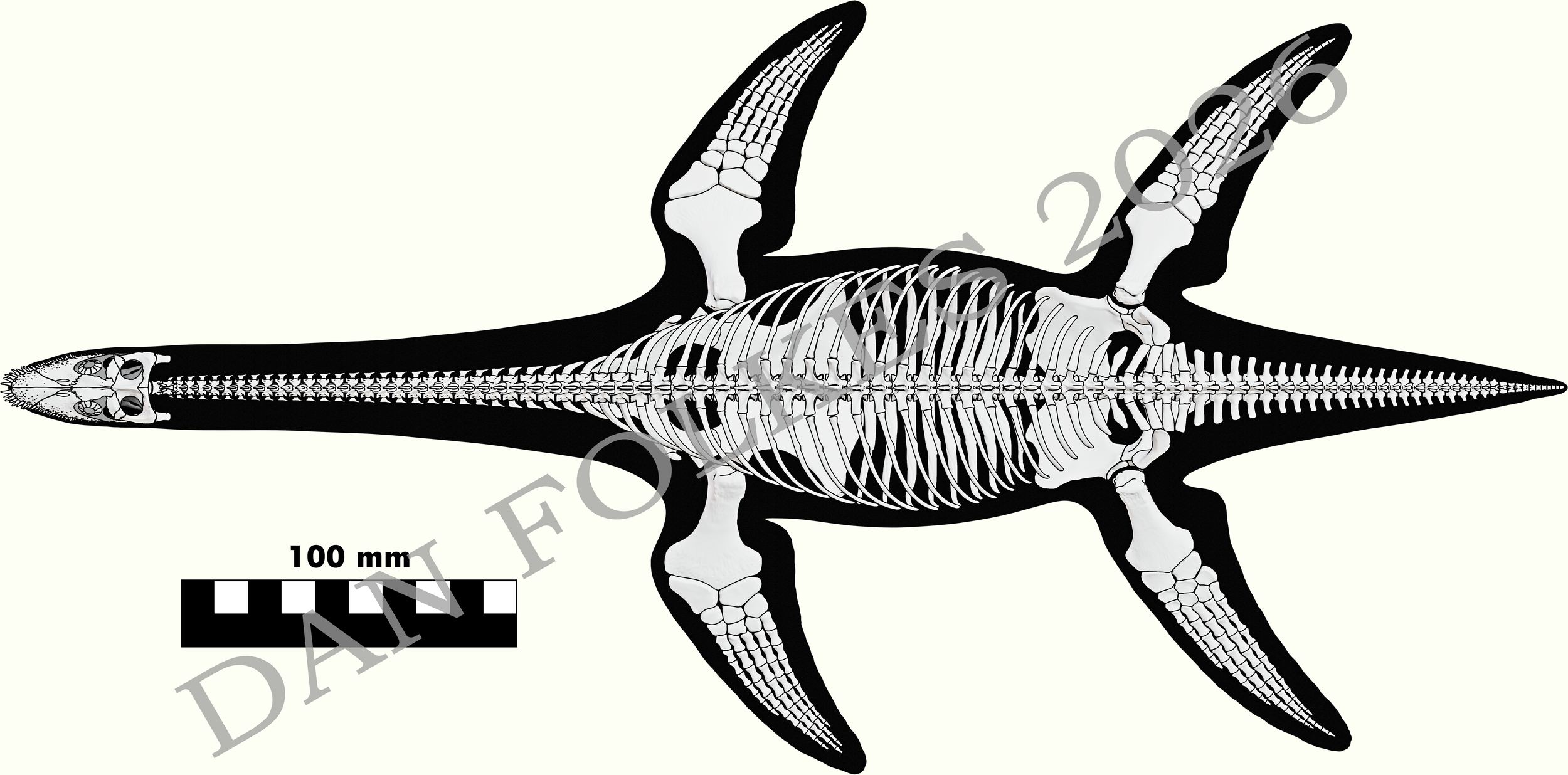
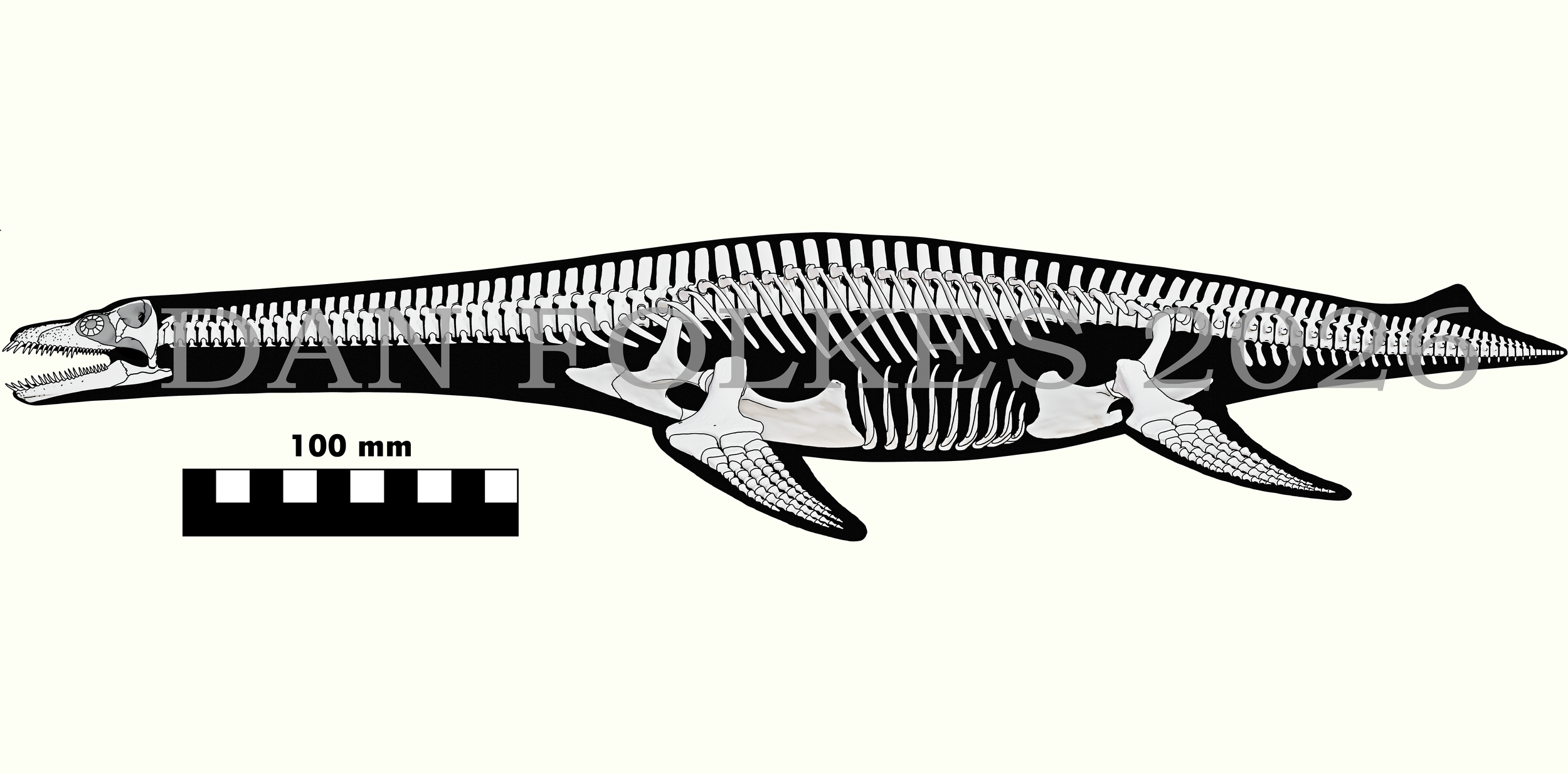
Cryptoclidus - an anatomical reconstruction and brief description.
I was contacted recently by my friend Joe Thompson (@southcoastfossils) to create a reconstruction of the well-known plesiosaur Cryptoclidus - a taxon known (mostly) from the Mid-Late Jurassic of Europe. Of course, I couldn’t turn down this offer, as I am very fond of marine reptiles, and plesiosaurs in general.
Cryptoclidus is a taxon with a long history, like many other marine reptiles discovered early in Palaeontology. Today, two species of Cryptoclidus are recognised: C. eurymerus, and C. richardsoni, both hailing from the Oxford Clay Formation of the UK. C. eurymerus is by far the more well-known of the two species, with multiple near-complete specimens known to science. This taxon is unlike many other plesiosaurs in a variety of ways, but perhaps most evidently by the shape of the humerus, which is incredibly broad in width and (as far as I know) unlike any other plesiosaur known. This, coupled with the relatively short body for a plesiosauroid, gives Cryptoclidus a squat, “rotund” appearance.
Reconstructions of Cryptoclidus have been attempted a handful of times in the literature. The first such attempt I am aware of is a reconstruction in Andrews (1910) based on a remarkably complete adult specimen, NHMUK PV R 2860, now designated as the neotype of C. eurymerus. Perhaps the most well known/widely used is the lateral skeletal reconstruction featured in Brown (1981), a paper which also attempts to reconstruct the cranial material of Cryptoclidus. Most recently, a (simplistic) reconstruction of Cryptoclidus is featured in Zhao (2026) alongside a variety of other plesiosaurs. You can see these reconstructions, and learn more about Cryptoclidus, from Dr. Adam Smith’s Plesiosaur Directory here.
My reconstruction (below) attempts to incorporate the most recent literature and current scientific consensus on Cryptoclidus and plesiosaur anatomy to create an accurate picture of this well-represented taxon. Without further ado, let’s dive right in!
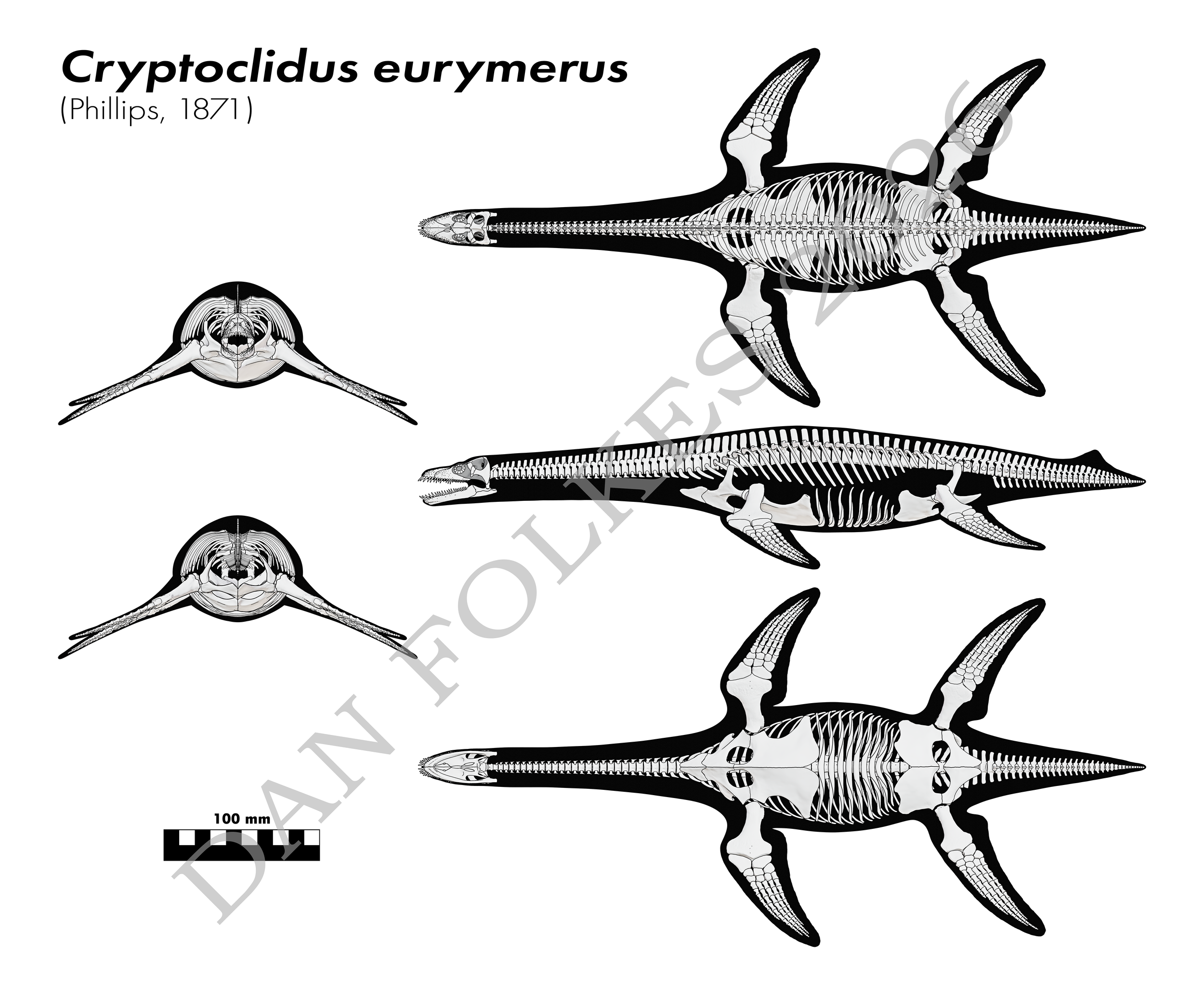
Skeletal diagram of Cryptoclidus eurymerus, mostly based on an (unpublished) specimen, with gaps filled with HMG V1104, NHMUK PV R 2860, and NHMUK PV R 3730. Skull almost entirely based on specimens PETMG R. 283. 412 and LEICT G1.2015.
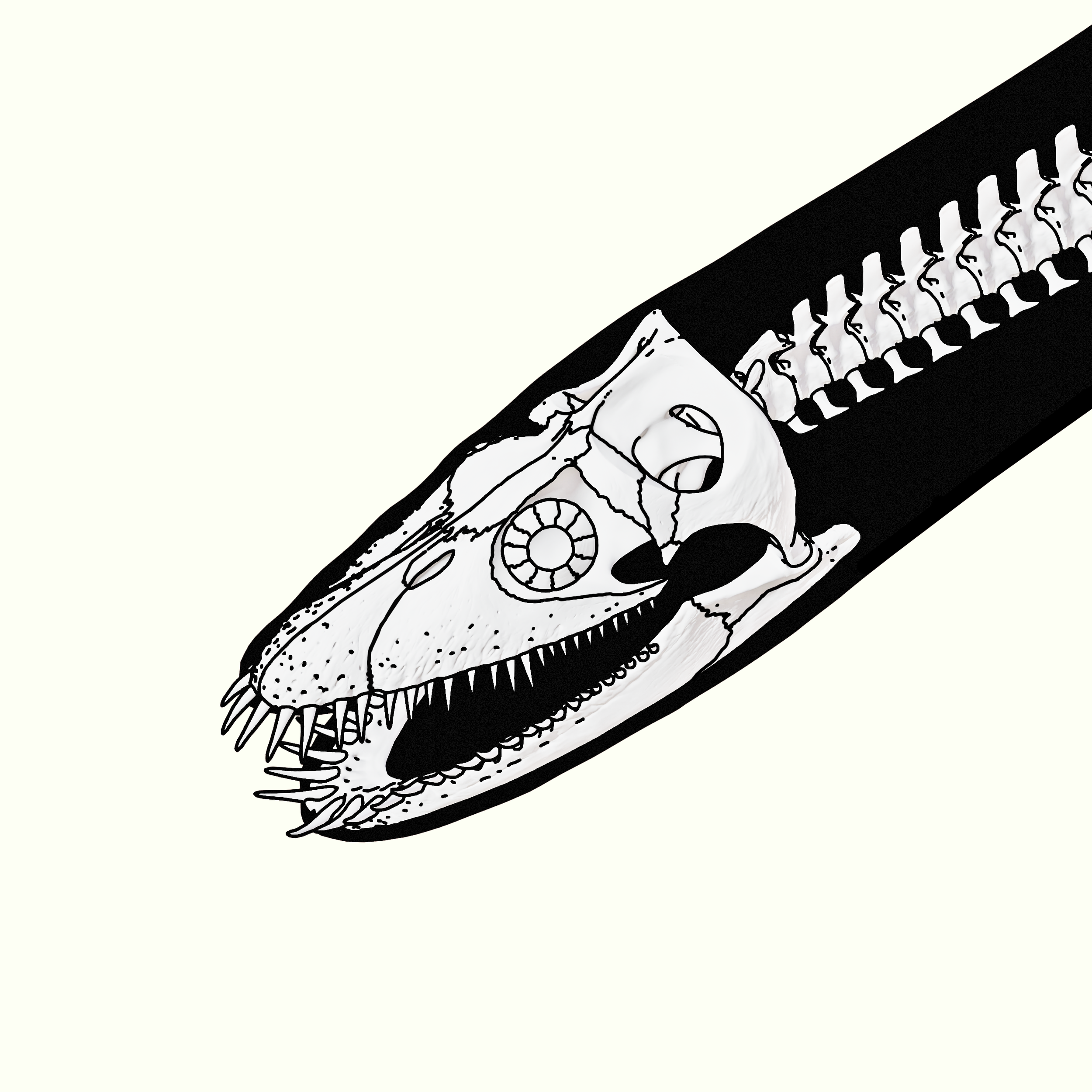
SKULL
The skull of my reconstruction is largely based on two exquisitely preserved Cryptoclidus skulls, PETMG R. 283. 412 and LEICT G1.2015, the latter of which is better preserved, with PETMG R. 283. 412 being more flattened.
The skull closely follows advice from Dr. Mark Evans, who gave me advice on my reconstruction. Following the discovery and 3D scanning of LEICT G1.2015, some of the characters observed in PETMG R. 283. 412 can be confirmed as genuine and not taphonomic; these include a highly reduced jugal disconnected from the maxilla, a crenulous orbital margin, and a rather fragile and flexible skull. Dr. Evans suggests that these features were likely shared with the majority, if not all, cryptoclidids, and may have been a result of the proposed “sieve feeding” these creatures employed, in which sediment was drawn into the mouth and then “sieved” through the numerous thin teeth lining the oral margin. You can find more info at Dr. Evans’ talk, recorded at the 65th Symposium on Vertebrate Palaeontology and Comparative Anatomy, University of Birmingham, here.
POSTCRANIA
As the caption mentions, many of the details of the postcrania in my reconstruction were based on a currently undescribed, well-known specimen of C. eurymerus. The proportions of this specimen are presented here and corroborate greatly with the proportions of other known adult specimens of Cryptoclidus, such as NHMUK PV R 2860 and HMG V1104. The torso is broad, and the articulated ribs and gastralia corroborate a reconstructed cross-section published in O’Keefe et al. (2011). Chatting with Tosha Hollman (aka Fishboy), who has worked extensively with marine reptiles, agrees with me that the pectoral and pelvic girdles wouldn’t have been as flat in Cryptoclidus, and by extension other plesiosaurs, as is sometimes reconstructed - with the coracoid and pubis curving upwards in line with the curvature of the gastralia and not just being a flat slab of bone somehow unrelated to the form of the body, as is sometimes reconstructed.